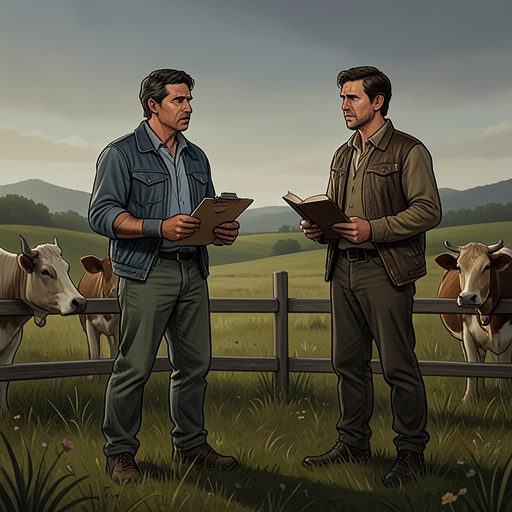
Nathan Oliver–Mark Yelland dispute
The LighthouseNathan Oliver and Mark Yelland’s dispute turns a dinner-table disagreement about a forthcoming novel into a confrontation over laboratory research, animal suffering, and the consequences of revealing information. Yelland sees Oliver’s fictional laboratory director as a potentially damaging portrait of himself; Oliver rejects that identification and insists that his interest in the laboratory was factual, not personal. Beneath their competing claims about fiction and scientific responsibility lies a practical danger: a junior member of Yelland’s staff has resigned after speaking to Oliver, while Yelland believes the novel could put both his research and his family at risk.
The dispute at dinner
The confrontation begins when Yelland, seated across from Oliver, delays eating and raises his knife as if it were a weapon. He asks whether the arrogant, unfeeling laboratory director in Oliver’s novel, due out the following year, is meant to represent him. The gesture gives the exchange a quality of challenge, but the argument is not simply about a resemblance. Yelland believes Oliver has acquired information about his laboratory by questioning a junior member of staff, and he wants to know how Oliver learned the researcher’s name and what he asked.
Oliver denies that he is a plagiarist of life and says that he uses himself as his living model. He presents his inquiry as research into facts: staffing levels, animal-care conditions, feeding, and how the animals were obtained. He says he asked about the organization of the laboratory, not the personalities in it. His distinction is important to his defense: he claims a writer’s need to understand how people act, while denying that he sought private judgments about how they feel. Yelland, however, considers the questions and the information they produced inseparable from the people and work they concern.
Fiction, information, and consequences
For Yelland, the novel’s fictional status offers little protection. He believes readers will take its director as a portrait of him, and says Oliver knows he cannot sue. Publicity, rather than legal action, is what he wants to avoid. He also fears that the portrayal will give the animal-liberation movement a gift and jeopardize research he regards as life-saving. He objects not only to what Oliver may publish, but to the route by which the information reached him: the junior researcher, he says, had no right to disclose it.
That objection has already had a concrete consequence. Yelland says the young man has resigned, although he had been one of his most able staff members. Yelland regards the loss as damaging to important research and possibly to the researcher’s future in science. Oliver answers that he cannot control what people choose to tell him and questions the young man’s commitment. The exchange therefore turns on competing accounts of responsibility: Yelland emphasizes the effects of disclosure on a worker and a research program; Oliver separates his own questions from the choices of the person who answered them.
The proofs intensify the conflict. Yelland has read them and believes the novel’s director can be recognized as himself, but Oliver challenges his reading, suggesting that Yelland has either misunderstood a more sympathetic and complex character or imposed his own fears on the fictional creation. Oliver also asks how Yelland obtained the proofs, since their distribution is tightly controlled by the publisher. Yelland’s reply—that publishing houses, like laboratories, have subversives—extends their suspicion beyond the two men. Neither accepts the other’s account of how knowledge should be guarded or interpreted.
Animal suffering and scientific purpose
The argument’s ethical center is the use of primates in laboratory experiments. Yelland defends his work through its intended benefit to patients with Parkinson’s disease and cystic fibrosis, and through the sacrifices made by him and his colleagues in pursuing cures. Oliver counters that the animals bear the pain while researchers receive the glory. He asks whether the pursuit of scientific priority can be as ruthless as the commercial marketplace, challenging the idea that beneficial aims make the process morally uncomplicated.
Yelland turns that challenge back on Oliver’s conduct. Oliver is eating guinea fowl, wears leather, and may take milk with his coffee; Yelland argues that concern for animals should also encompass the ways animals are slaughtered for food. Oliver does not deny the inconsistency in his own life. He calls himself a carnivore, accepts predation as part of nature, and says he could wish food animals were killed more humanely. But he draws a distinction between eating animals and using primates in experiments that cannot benefit the animal itself, especially when the practice rests on human claims of superiority over other species. He acknowledges that the Home Office monitors permissible pain and seeks clarification about analgesics, but treats this as only a small alleviation, not a resolution of the moral question.
The scene does not settle whether the laboratory’s goals justify its methods, or whether Oliver’s selective concern weakens his criticism. Instead, the meal makes the argument tangible: Yelland invokes the guinea fowl on Oliver’s plate, while Oliver continues carefully dissecting it. Their exchange exposes the difference between a general principle and the choices each man makes, without making those choices equivalent or ending the disagreement.
A conflict left open
As the dinner continues, the argument becomes less a mutual debate than an antiphonic exchange in which Yelland alone appears genuinely passionate. Oliver says he has no strong views on the issue and distinguishes his characters’ opinions from his own. Yelland rejects that as evasion: a writer gives characters a voice, he argues, and Oliver cannot plausibly claim he sought only routine background information after learning what the junior researcher disclosed. The disagreement thus returns to the novel itself: whether fiction merely uses information or can give that information a public force its source may not be able to control.
Yelland leaves before coffee, crumpling his napkin and throwing it onto his plate. He hopes Oliver will leave the island the next day and says there is not room there for both of them. The abrupt departure gives the conflict an immediate personal consequence, but no reconciliation or resolution follows. Oliver’s novel remains forthcoming, Yelland’s research remains, in his view, seriously at risk, and the ethical and professional claims the two men have made remain opposed.